What STAAR actually asks, what the Student Success Tool will change, and the vocabulary, frequencies, and prompts you need for grades 3 through English II. Based on TEA’s released tests, answer keys, and House Bill 8 materials.
Updated October 14, 2026 · Bookmark it; it grows as TEA releases more.
House Bill 8
What’s changing: STAAR to SST
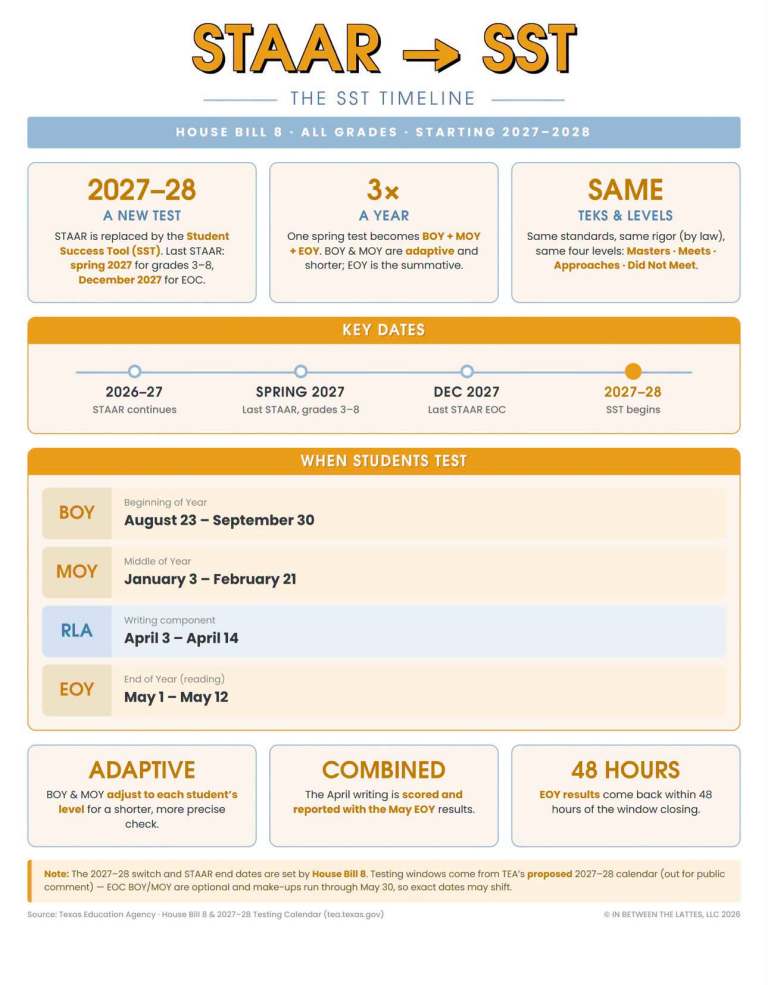
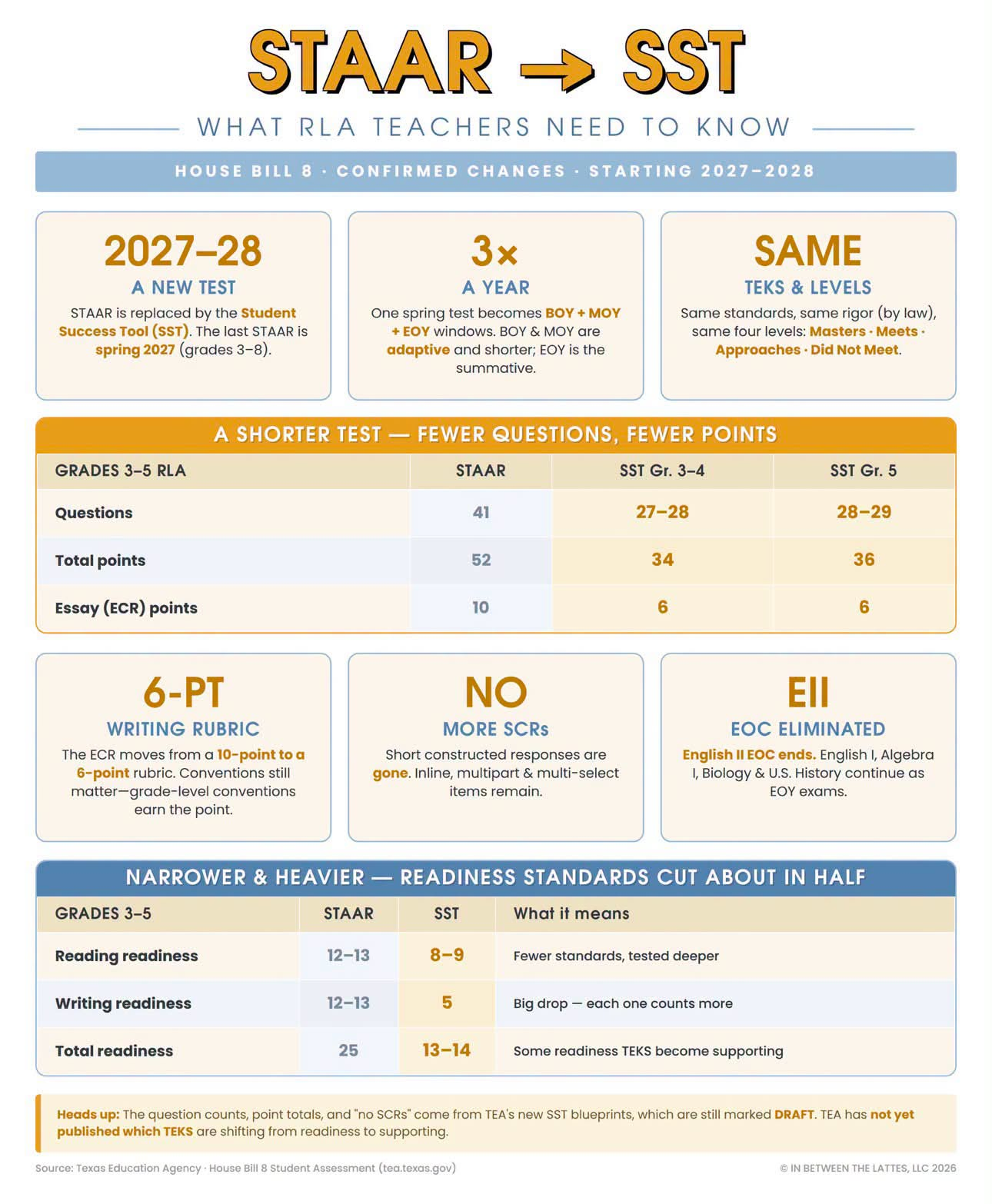
STAAR runs through spring 2027. The Student Success Tool starts in 2027–28: same TEKS, same four performance levels, but adaptive, three times a year, with a single essay on its own day. Nothing changes for this year’s STAAR.
STAAR to SST timelineNothing changes for this year’s test.
STAAR
STAAR ends
SST
Spring 2026Spring 2027Dec 20272027–28
STAAR as usual → last STAAR for grades 3–8 → last STAAR EOC → first SST year
SST testing scheduleTesting windows during the school year.
ONE YEAR
Aug–SeptJan–FebApril 1–15May
windows across one school year
optional check-inwriting dayrequired summative
1 spring test → 3 checkpoints + 1 writing day
BOY
Beginning of year4th Monday in August → Sept 30Optional · adaptive · no writing · about 60–75 minutes
MOY
Middle of yearJanuary → FebruaryOptional · adaptive · no writing · about 60–75 minutes
ECR
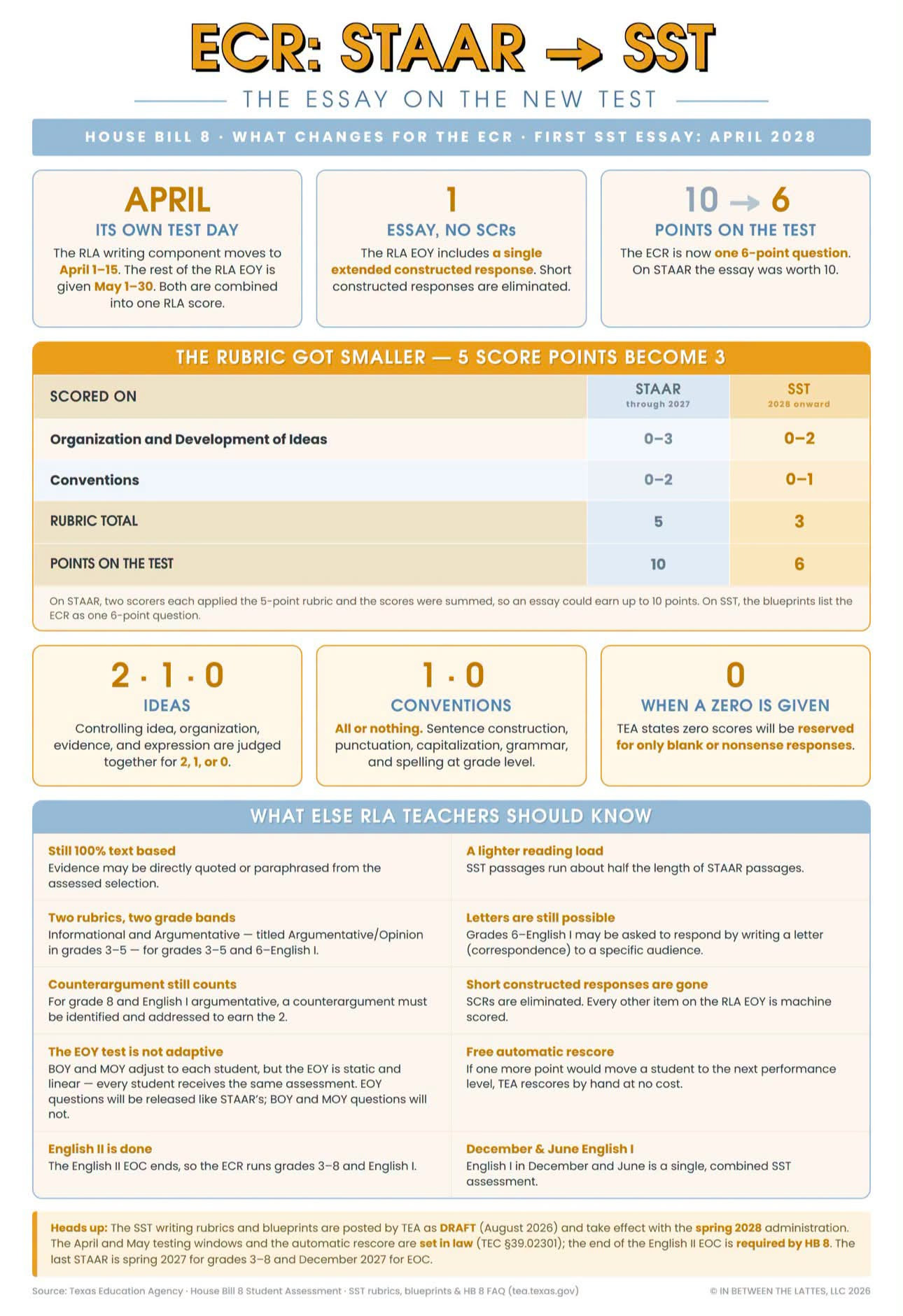
RLA writing dayApril 1 → 15One essay on its own day · 3-point rubric × 2 = 6 points · no SCRs
EOY
End of yearMayRequired · the summative test · released afterward like STAAR · about 90–105 minutes
STAAR and SST comparison
ComparisonSTAAR through 2027SST from 2027–28
Tests each yearOne, in the springThree: BOY, MOY, and EOY
How it adaptsSame form for everyoneBOY and MOY adjust to each student; EOY is one fixed form
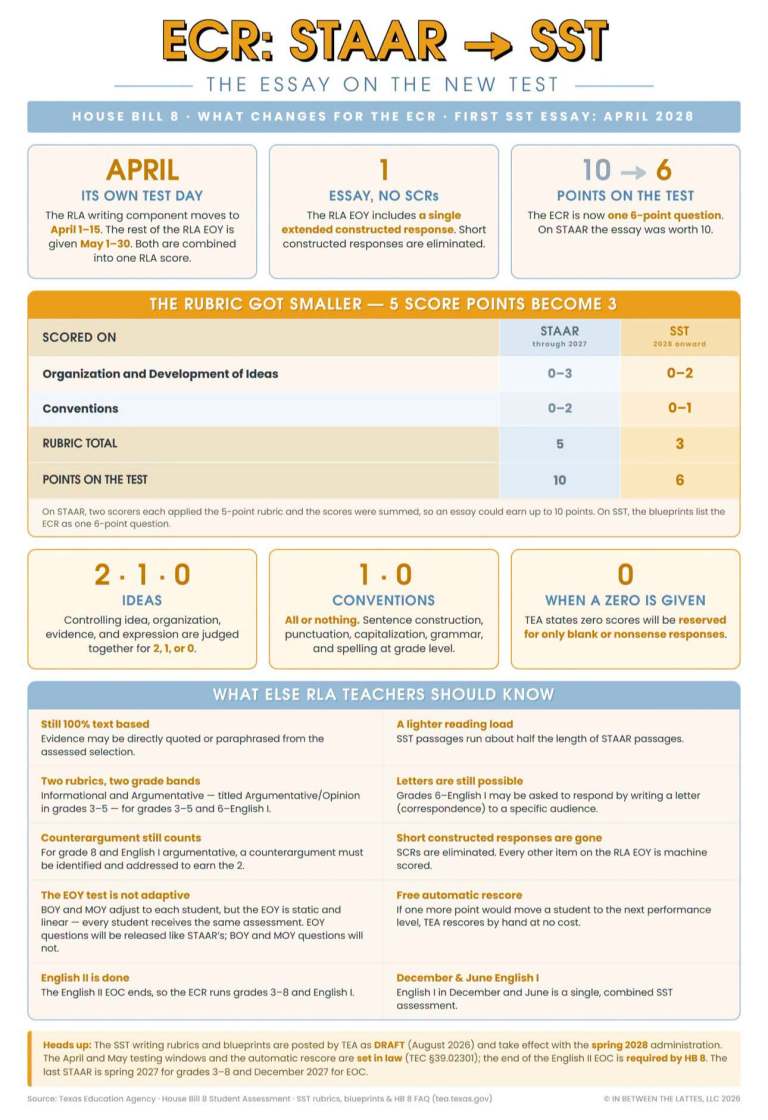
The essayECR worth 10 points, plus short constructed responses, on test dayOne ECR on its own April day, 3-point rubric doubled to 6 points; SCRs are gone
The zero ruleA 0 on ideas forces a 0 on conventionsGone: each rubric line scored on its own
ResultsWeeks laterWithin two business days
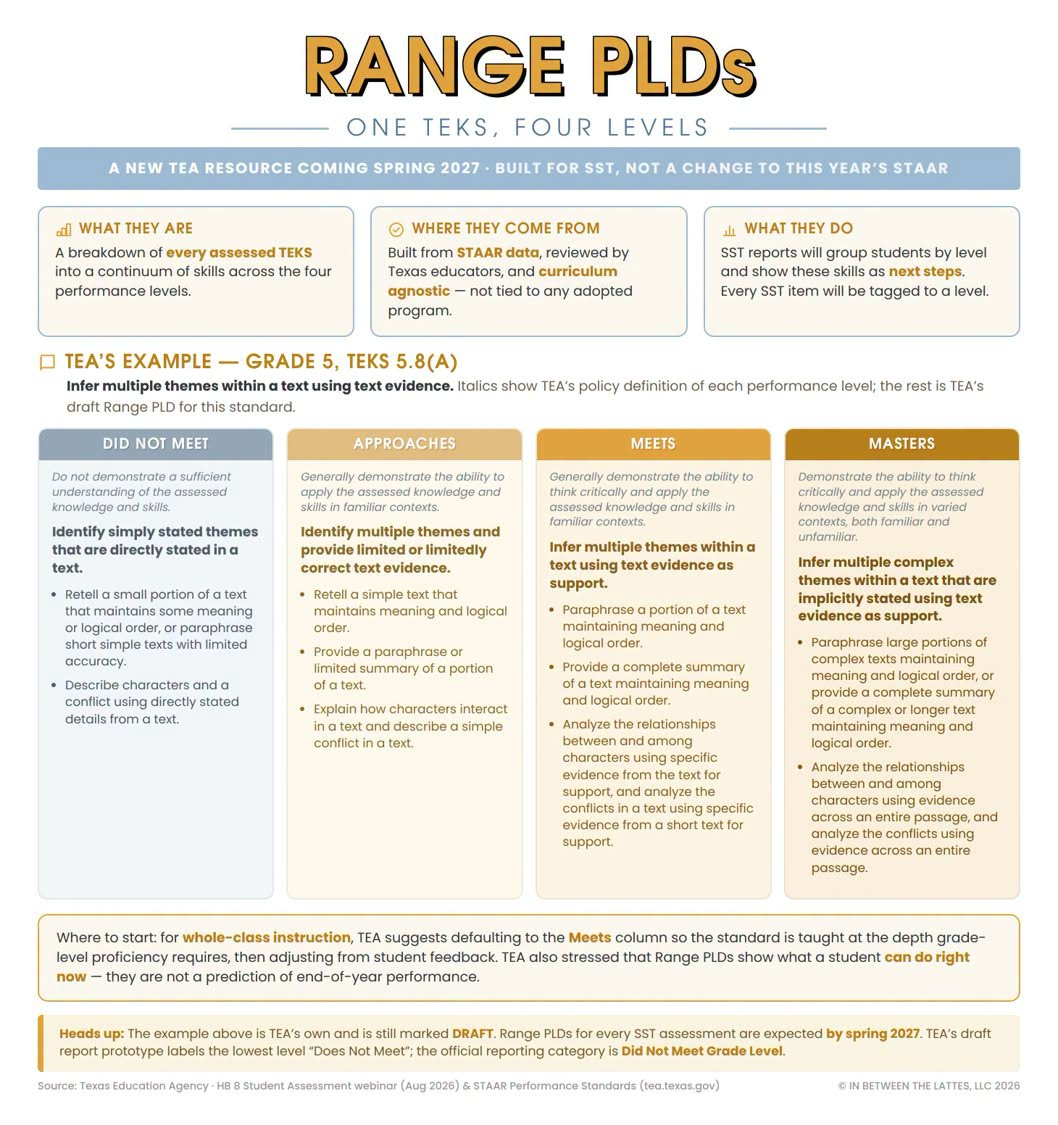
TEKS and levelsCurrent TEKS · Did Not Meet, Approaches, Meets, MastersSame TEKS · same four levels, now described per TEKS by the Range PLDs
House Bill 8What’s coming for RLAThe gatekeeper zero goes away, the RLA EOY splits across two testing days, and results come back within two business days.
House Bill 8Range PLDs: one TEKS, four levelsTEA’s new resource for SST: every assessed TEKS broken into a continuum across Did Not Meet, Approaches, Meets and Masters, with TEA’s own 5.8(A) example.
The graphics I post as TEA releases each test, plus the numbers behind them as charts you can move through by grade and year. Open a graphic, download the PDF, or explore the data.
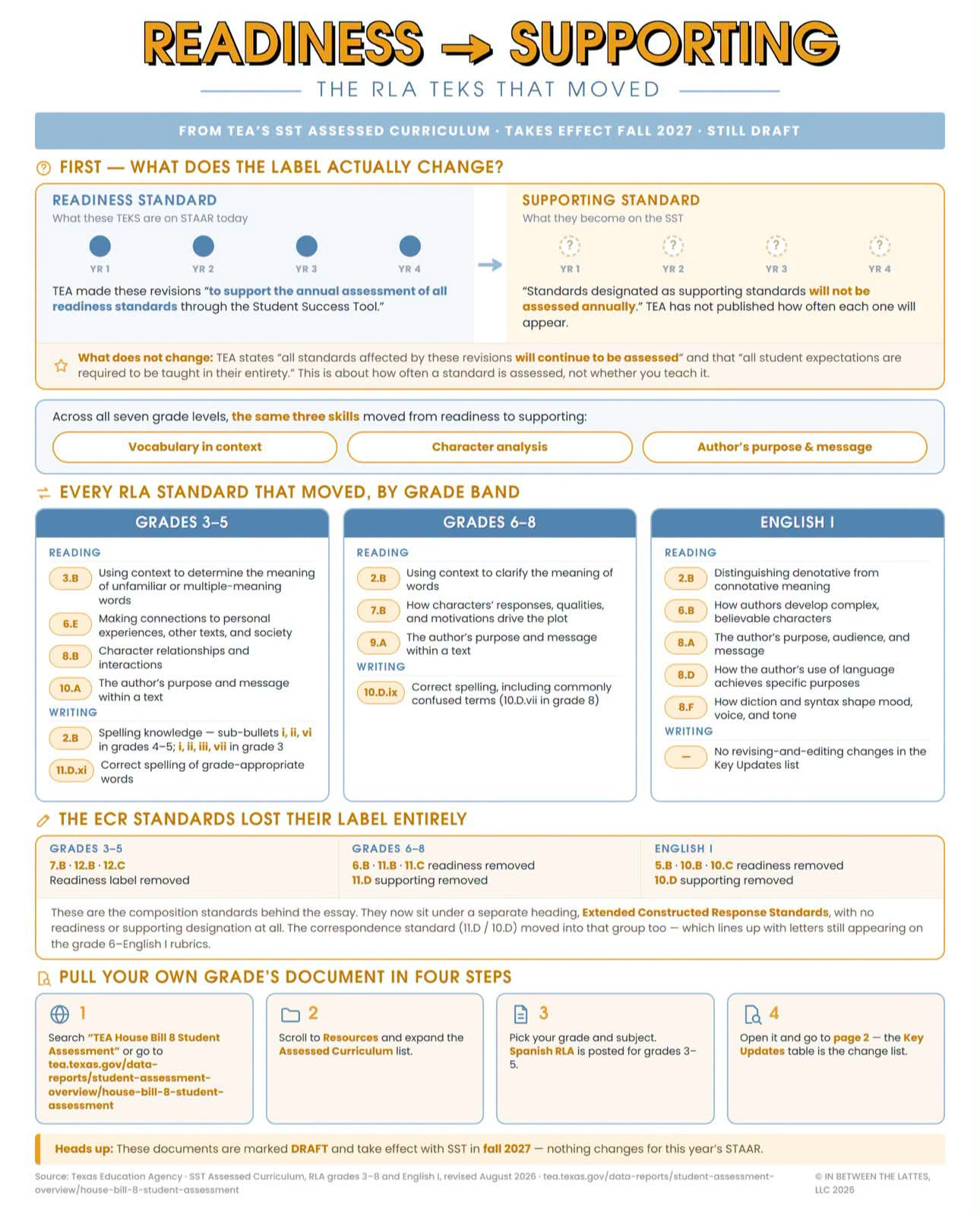
House Bill 8Readiness to supporting: the RLA TEKS that movedDraft assessed-curriculum changes, organized by grade band.
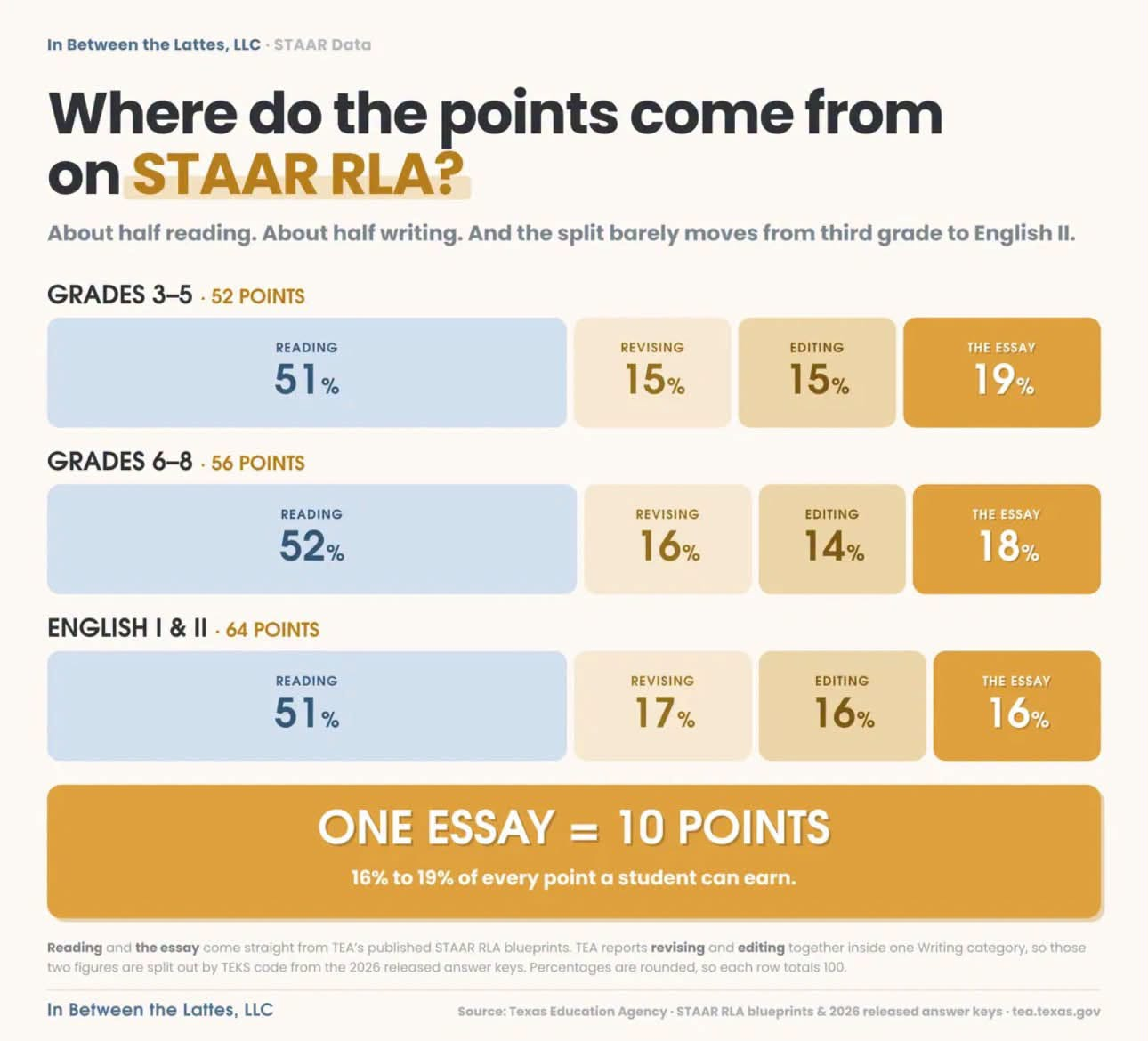
Reading and writing each account for about half of the available points across grades 3 through English II.
Grades 3–5 · 52 points
Reading51%
Revising15%
Editing15%
The essay19%
Grades 6–8 · 56 points
Reading52%
Revising16%
Editing14%
The essay18%
English I & II · 64 points
Reading51%
Revising17%
Editing16%
The essay16%
One essay = 10 points16% to 19% of every point a student can earn.
Reading and the essay come straight from TEA’s published STAAR RLA blueprints. TEA reports revising and editing together inside one Writing category, so those two figures are split out by TEKS code from the 2026 released answer keys. Percentages are rounded, so each row totals 100.
Source: Texas Education Agency · STAAR RLA blueprints & 2026 released answer keys. Data provided by In Between the Lattes, LLC.
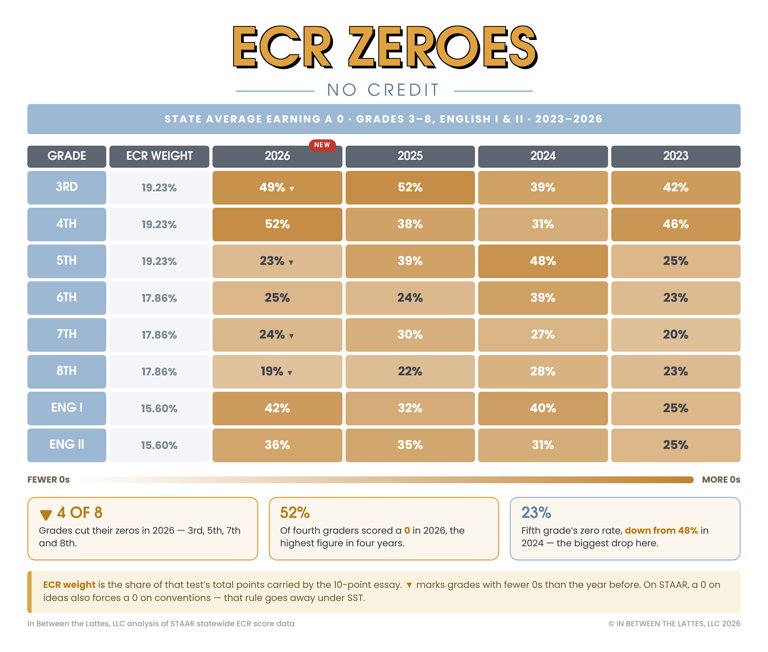
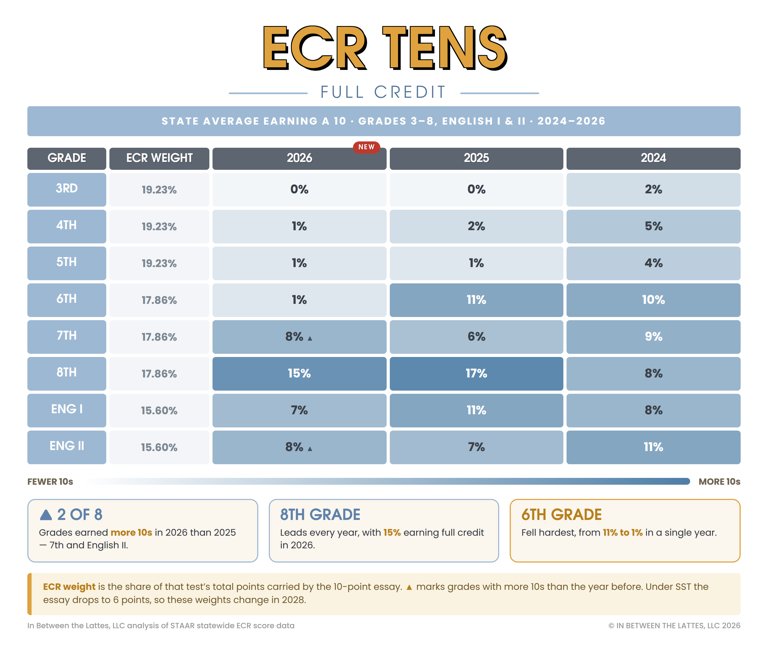
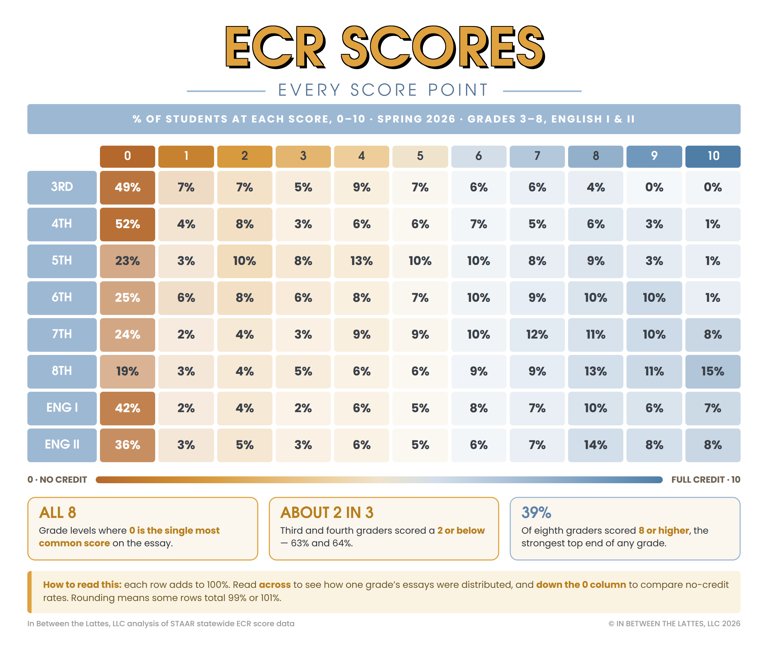
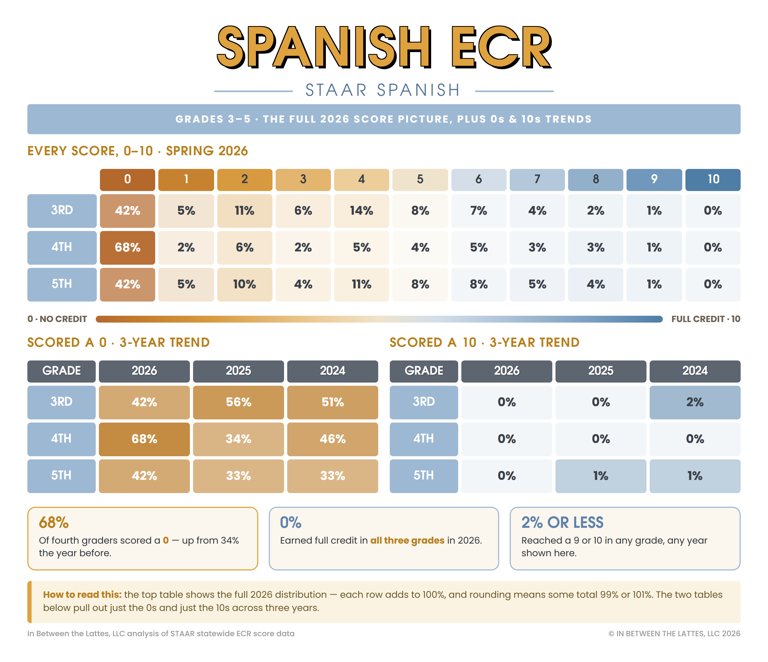
ECR scoresECR zeroes: no credit, 2023 to 2026The share of students statewide who scored a 0 on the essay, grade by grade, four years running.
TrendsReading vs. writing: average percent correctAverage percent correct on the multiple-choice reading items against the revising and editing items, 2024 to 2026.
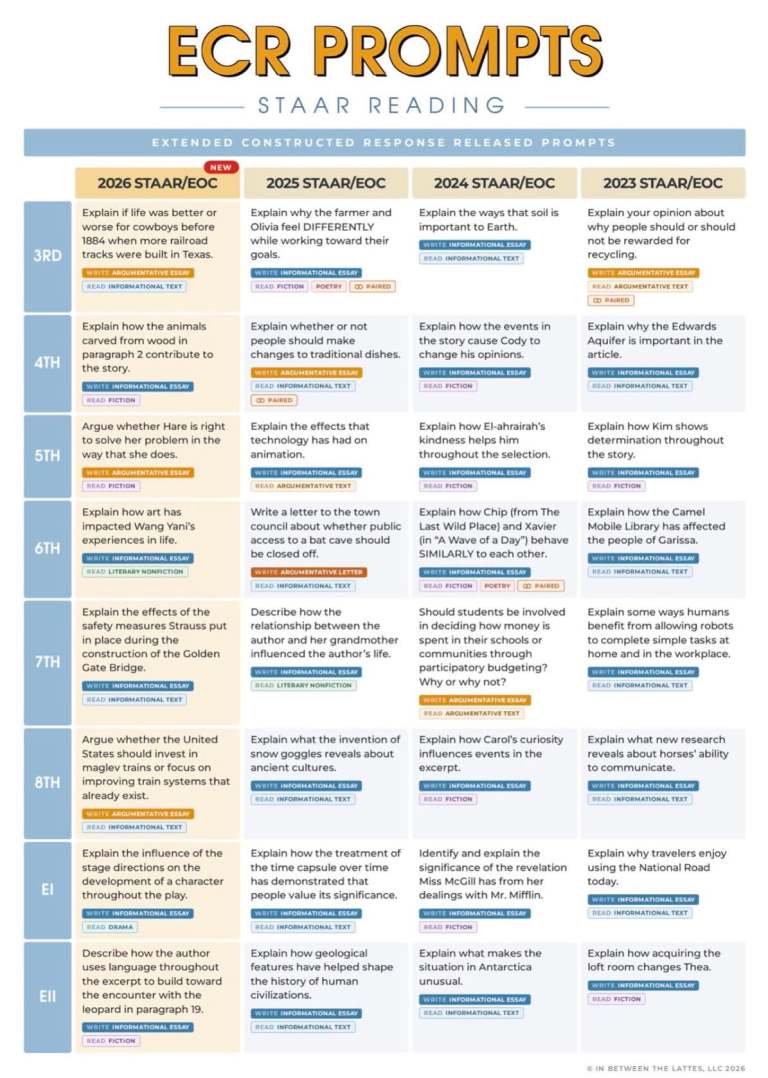
Released promptsECR prompts, 2023 to 2026Every extended constructed response prompt released for grades 3 through English II, with essay type and the genre students read.
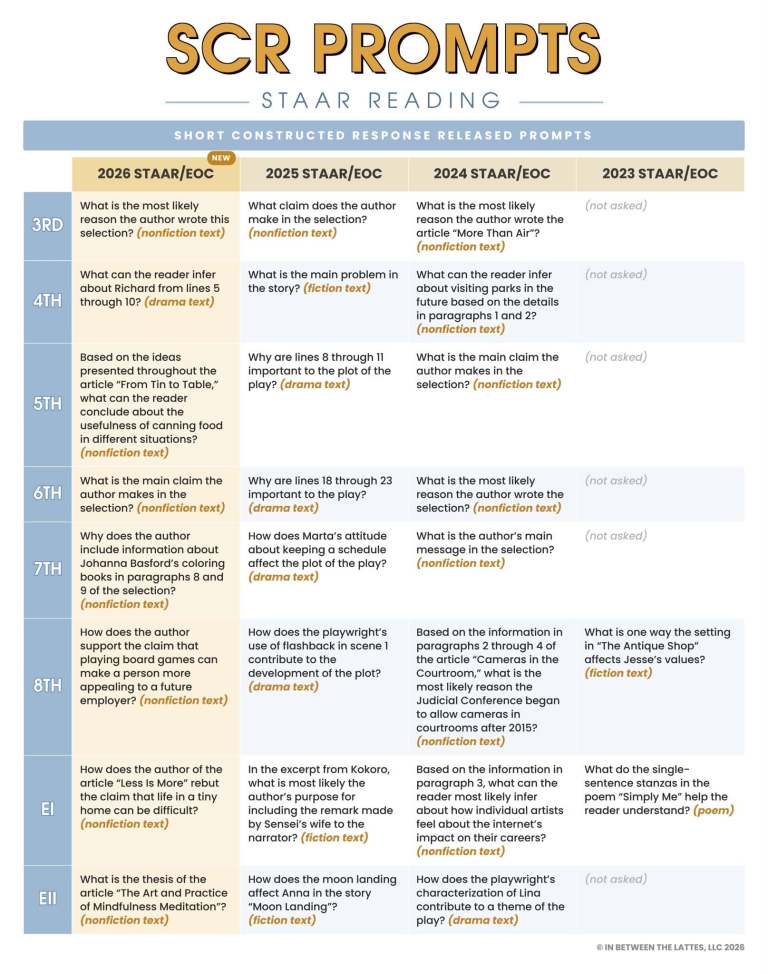
Released promptsSCR prompts: Reading, 2023 to 2026The short constructed response reading questions, by grade and year, with the text type each one targets.
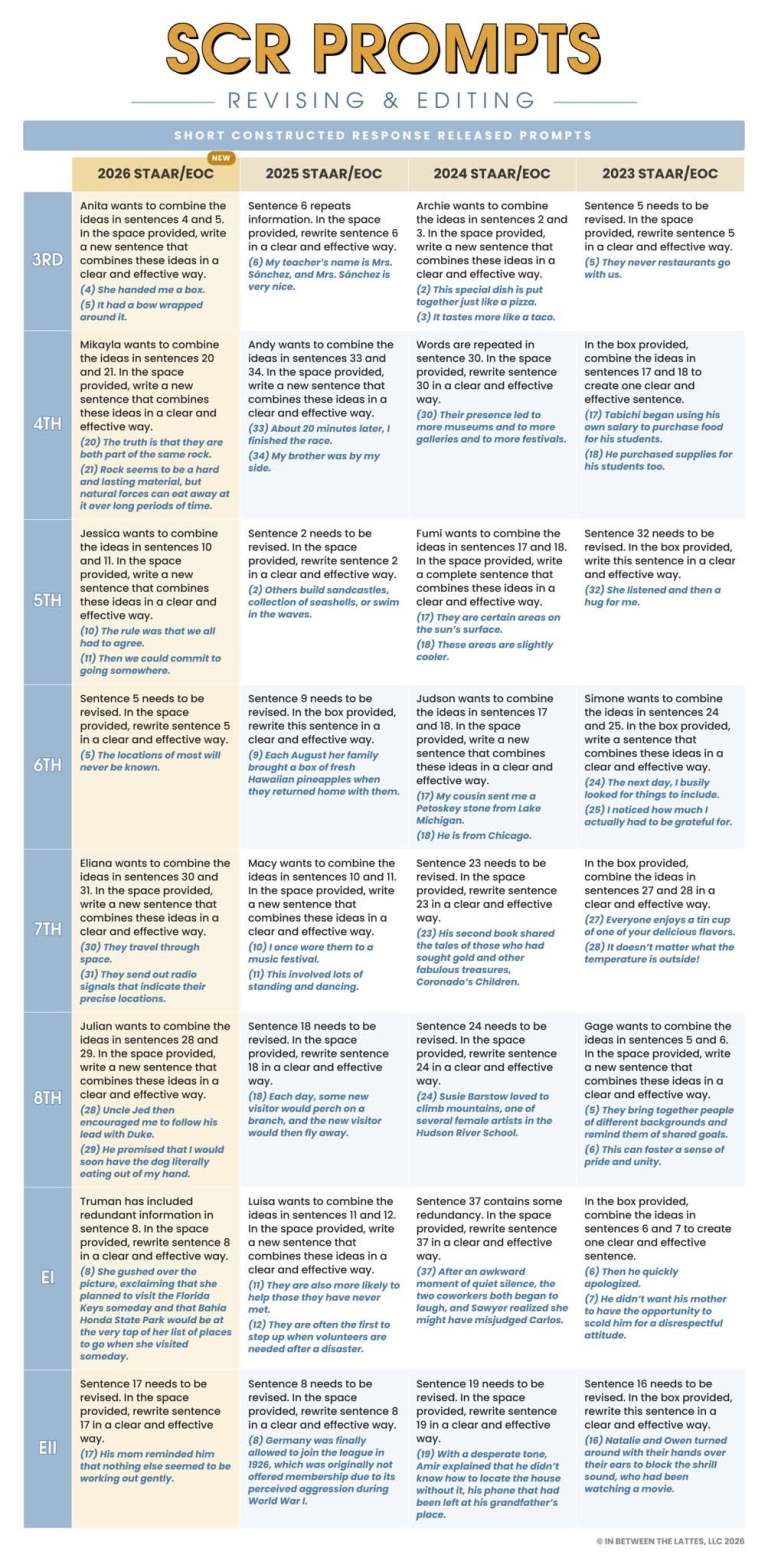
Released promptsSCR prompts: Revising and Editing, 2023 to 2026The combine-the-sentences and rewrite-the-sentence items, with the exact sentences students were given.
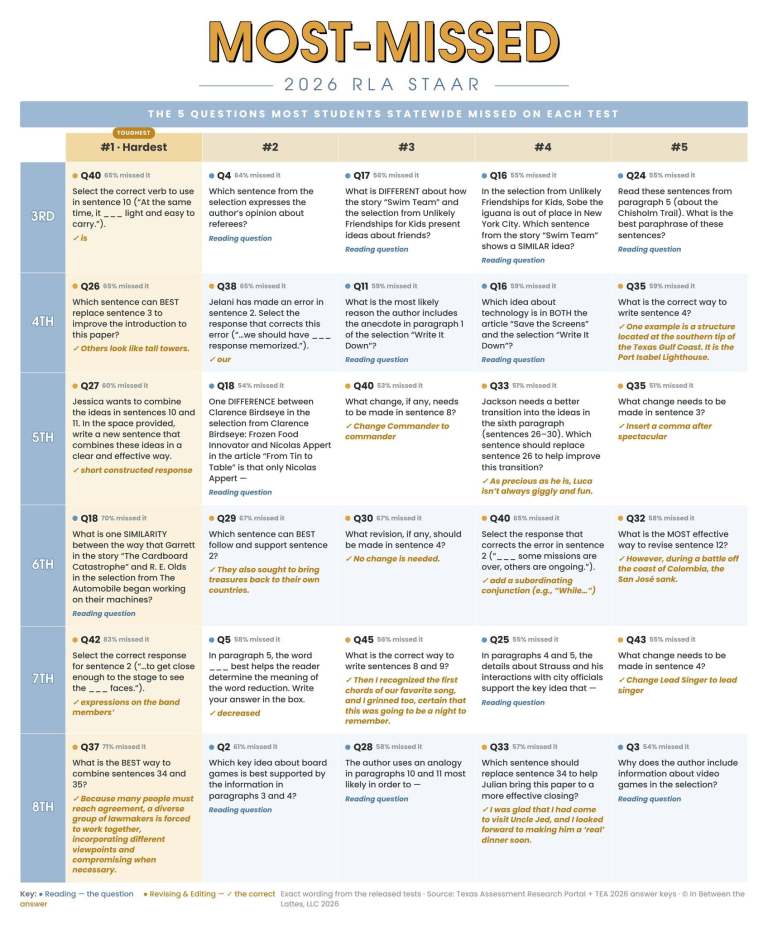
2026 dataMost-missed questions on the 2026 testsThe five questions most students statewide missed on each RLA STAAR, grades 3 through 8, with the correct answers.
TrendsEditing frequency: grammar concepts, 2023 to 2026How often each editing concept appeared in answer choices across four years of tests, grade by grade.
Members get the same analysis on every released passage: the questions, the prompts, the most-missed items and the answer keys, organized by grade and year. See the membership →
ECR trends
Patterns in published STAAR RLA scoring-guide samples, 2023–2026.
Vocabulary & terms
The words STAAR uses to ask the question
Students miss questions they could answer because they don’t know what convey, emphasize or organizational structure means. Pick a list, pick a grade, search a word.
Where the definitions come from. Every definition on this page is written in the plain, student-facing style of the pop-up definitions students see with Content and Language Supports on TEA’s online test platform (Cambium), so the word means the same thing here that it means on test day.
Members get the printable vocabulary sets, the STAAR-vocabulary warm-ups and the task cards built on these exact words. See the membership →
From TEA’s answer keys, 2021–2026
What STAAR actually asks: question frequency by TEKS
TEA codes every released item to one TEKS on its answer key. This is that count for every assessed TEKS, test by test, with a reading view, a revising and editing view, and a skill-family view that adds up the TEKS teachers group together (author’s purpose, vocabulary, and so on).
Counted from TEA’s published answer keys for the released tests of 2021 through 2026. The 2021 and 2022 tests were the old design (more reading items, no revising or editing on the RLA test for grades 3–8); 2023 onward is the redesign. TEA files many inference questions under text evidence, paired passages and literary elements rather than under the inference TEKS itself, so the skill-family view is the fairest way to compare.
Members see every released item behind these counts, by TEKS and by year, with the question wording and the IBTL stem bank back to 2018. See the membership →
Released question stems
How STAAR words the question
Real stems from the released tests for every assessed reading TEKS, newest first, and the same stems sorted the way SST will report them: Approaches, Meets, Masters.
SST sorting is evolving. The sorting of these question stems by SST performance level will continue to be refined as TEA supplies additional information and ongoing updates.
Every stem, every year, sorted by SST level. Members get all 2,100+ released items from 2021 to 2026 organized by TEKS and filtered by test year, the IBTL stem bank back to 2018, the revising and editing stems, and every stem sorted into Approaches, Meets and Masters with a level descriptor for each TEKS. See the membership
Statewide item analysis
The questions Texas students miss most
Every released STAAR RLA item since 2021, ranked by the share of students statewide who got it right. Pick a grade and a year for that test’s ten hardest questions, or look across years to see which skills stay hard.
Where the numbers come from. Percent correct is TEA’s statewide item analysis: the Statewide Item Analysis Reports for 2021–2023 and the Texas Assessment Research Portal for 2024–2026, matched to TEA’s answer keys for the TEKS. Multi-part items show the share earning full credit.
Members get the same most-missed analysis inside the membership with the passages, the released questions and the answer keys side by side. See the membership →
Inside the membership
Released tests, passage by passage
Browse the passages and original released ECR prompt, then see the resources members can use with each passage.
Membership preview · Resource buttons show what is included. Downloads are for members only.
A little something for your classroom
Resource of the Week
Free download · Inferencing
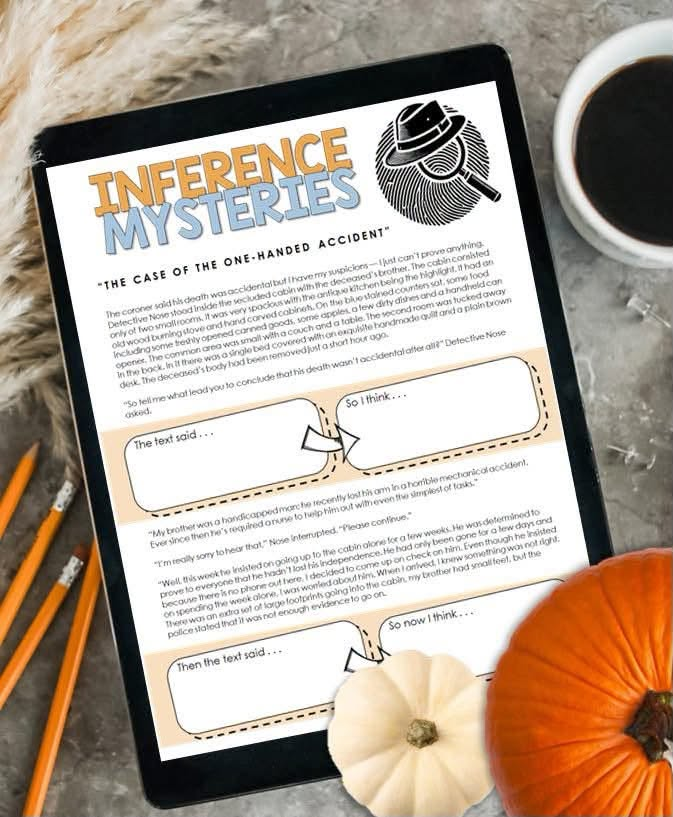
Inference Mysteries
This week’s resource focuses on the essential RLA skill of inferencing! Student inferencing is most effective when it is viewed as a continuum or a continual process throughout the reading of the text.
In the past, I had students make sporadic inferences without context at the end of reading, but I have found this inference continuum to be a far more effective approach. Students engage with the text, record the changes in their thinking, and evaluate the author’s purpose for revealing information in a specific order.
I like doing this with mystery stories (especially this time of year!), and I’m sharing one of these mysteries but have several others posted in the membership for members! Enjoy!
When you want the whole picture and not just the pattern
The resources on this page are free. The membership includes:
A bank of 1,000+ resources: ready-to-use reading, writing, and grammar lessons, task cards, warm-ups, organizers, and practice for grades 3 through English II.
ECR Tool Kit: like an athlete practicing individual skills, students practice the essay’s parts and the writing process’s steps forwards, backwards, and sideways, with engagement and reading work built in.
Bluebonnet support resources: a lesson-by-lesson companion for grades 3–5, connecting IBTL resources to the reading, writing, and revising-and-editing work within each unit.
Released tests, passage by passage: individual passages and questions, original released prompts, and related ECR and SCR practice resources.
Question stems and vocabulary: released stems organized by TEKS and test year, academic vocabulary, and an evolving SST performance-level sort.
STAAR Data & Trends: essay-score trends, most-missed questions, editing-concept frequency, and student and teacher data pages.
Planning tools: scope and sequence, a year-long pacing guide, the Lesson Designer, and My Plans to keep your planning work together.
Intro lessons: support for introducing the reading and writing skills students need before independent practice.
Spanish support resources: directions, teacher notes, sentence stems, and organizers for grades 3–5, with passages and prompts in English.
Live professional learning and replays: First Saturdays, summer events, and Countdown to STAAR.
PROVE it!, WRITE it!, and FIX it! are separate add-on tools and are not included in the membership.
Subscribe and receive 30 FREE skills-based graphic organizers to use with any text! Also, be the first to know about new arrivals, sales, and special events.